new release

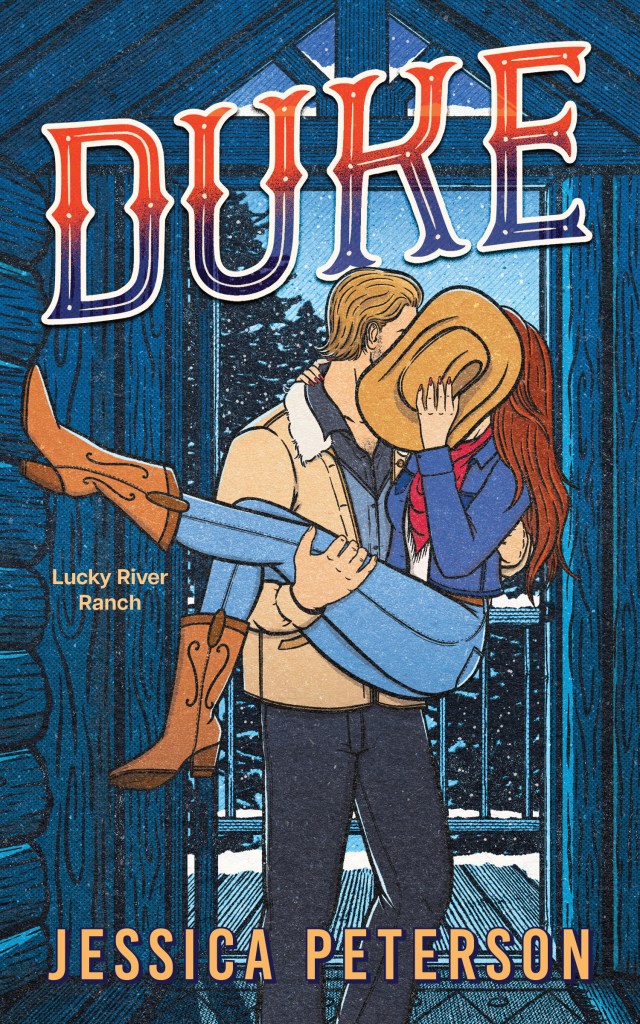
✍🏻 Professor Romance’s Reviews: Jessica Peterson’s Duke ✍🏻

Book cover of 'Duke' by Jessica Peterson featuring a cowboy lifting a woman inside a rustic cabin, highlighting a romantic connection.

Overall Grade: A

Tropes: surprise pregnancy; forced proximity; friends to lovers; insta-attraction; cowboy romance; small town romance; golden retriever MMC/black cat FMC

I think of myself as “not an easy woman.” As a Gen Xer raised by Boomer parents, I live with a constant internal dialogue—who I am versus who others see versus who I wish I could be. This overthinking creates protective barriers that, while shielding a vulnerable heart, can leave you profoundly alone.

When authors like Jessica Peterson write these complex women who find men willing to love them fiercely, I feel seen. It’s bittersweet but hopeful—knowing that somewhere in this vast world exist people who look past our carefully constructed walls to the tender hearts beneath.

This is why I adored Duke, Peterson’s latest Lucky River Ranch novel. Duke and Wheeler inspire genuine emotion. Duke’s gift for seeing and loving Wheeler’s truth makes this story exceptional. Wheeler has spent a lifetime hearing lies about herself from her father and brother, their words born from their own insecurities. She’s countered those lies through hard work and success, but that independence comes at a cost—those old wounds make her guard against anything threatening to derail her carefully planned life.

Duke represents everything that could upend Wheeler’s world. The tension between their undeniable attraction and Wheeler’s determination to stay single adds rich complexity to their story. Duke is patient, tenacious, and intentional—qualities that make him irresistibly attractive. He becomes Wheeler’s friend first, lover second, creating a bond that’s both hard-won and deeply satisfying. Their relationship evolves from friendship to something eternal.

Peterson excels at crafting compelling narratives that propel readers forward. Her prose captures attention and holds it, while her ability to reveal a character’s core essence keeps readers invested. Her talent for writing independent, headstrong women who find partners who love them as they are—not as they need them to be—continues to resonate with her growing fanbase.

If you’re seeking a cowboy romance with genuine heart and emotional depth, Duke should be your next read.

In love and romance,

Professor A

new release, Review

✍🏻 Professor Romance’s Reviews: Helena Hunting’s If You Claim Me ✍🏻

Cover of the romance novel 'If You Claim Me' by Helena Hunting, featuring an illustration of a couple in wedding attire. The woman is wearing a white dress with a fitted bodice and flowing skirt, while the man is dressed in a maroon suit. The background is decorated with library elements and the title is prominently displayed in colorful text.

Overall Grade: A

Tropes: opposites attract; pro hockey romance; found family; grump/sunshine; librarian FMC with a heart of gold; misunderstood MMC; marriage of convenience

The fear of being vulnerable in love will always be my favorite romance theme. It makes my heart race and brings tears to my eyes every time. There’s nothing more terrifying than trusting someone with your heart, knowing they could destroy it with a single harsh word or action.

Helena Hunting absolutely nails this in If You Claim Me, her latest Toronto Terror book featuring Mildred “Dred” and Connor. This story took me on an emotional roller coaster from start to finish – and it’s easily my favorite in the series.

What I loved:

  • Connor’s quiet, devoted love for Dred
  • Dred’s ability to love even the most difficult people
  • The amazing friend group and found family
  • Connor calling Dred “darling” (swoon!)
  • The perfect balance of grumpy/sunshine and marriage of convenience tropes

The way these two struggle to open up to each other, even when it’s obvious they’re deeply in love, absolutely wrecked me. Hunting masterfully builds the tension until you’re practically screaming at them to just be honest with each other. And when they finally do? Happy tears guaranteed.

This reminds me so much of Little Lies (Lavender and Kody’s story), which is my other favorite Hunting book. Both couples share that same fear of revealing their true feelings, terrified of losing everything. The emotional depth in these two books shows a different side of Hunting – beyond her trademark steamy humor, she can write heart-wrenching emotion that stays with you long after the last page.

If You Claim Me is easily in my top 5 romance reads of 2025. If you love stories about two people learning to trust each other with their whole hearts, this book is an absolute must-read. Helena Hunting has earned a permanent spot on my auto-buy list.

In love and romance,

Professor A

new release, Review

✍🏻 Professor Romance’s Reviews: J. Saman’s Bossing My Holiday ✍🏻

Cover art for 'Bossing My Holiday' by J. Saman, featuring a woman in a red dress and two men in suits near a decorated Christmas tree with gifts and the Eiffel Tower in the background.

Overall Grade: A-

Tropes: MFM; holiday romance; workplace romance; enemies to lovers/hate to love; grumpy/sunshine; he falls first; golden retriever MMC

J. Saman’s Bossing My Holiday is the romance you’ll want to read if you’re a bit of a Scrooge when it comes to holiday romances. I oftentimes struggle with holiday romances: the overwrought Christmas innuendo, the romance that reeks of Hallmark Christmas with a side of spice. All of it makes me feel scroogey. 

But Bossing My Holiday is littered only with holiday references, with the setting of a family Christmas event as the only real holiday connection. 

Instead, this book is a spicy MFM workplace romance that is titillating. For your smut reader, Bossing My Holiday offers up a big helping of spicy romance. For your enemies to lovers. Saman has you covered. For those of you who love a golden retriever MMC, you’ll swoon over Braxton, one of the M’s in the MFM. For the reader who loves an adventurous, independent FMC, Waverly is crafted to take on Tristan and Braxton and hold them in their places. 

J. Saman has written a story that is the antithesis of your favorite Hallmark Christmas movie. Bossing My Holiday is the Christmas romance you didn’t know you needed to read.

In love and romance.

Professor A

new release, Review

✍🏻 Professor Romance’s Reviews: Kandi Steiner’s Stand Your Ground ✍🏻

Overall Grade: A

Tropes: professional hockey romance, opposites attract, spicy lessons, virgin hero, he falls first, he’s obsessed, doctor/patient, age gap, workplace romance, black cat/golden retriever, grumpy/sunshine

Resilience. This word, woven throughout her novels, explains why Kandi Steiner’s romances continue to captivate her readers. Steiner crafts characters who overcome personal emotional and mental struggles to reach beautifully rendered, emotionally grounded happy endings. Her earlier works, written during a period of personal growth, were gut-wrenching, angsty stories that turned readers’ souls inside out before piecing them back together. Her recent novels, inspired by her own happiness, retain that signature angst but take a different path. Rather than guiding readers through an almost spiritual journey toward understanding, they embrace heat and passion. The transcendent quality of her earlier angsty stories has evolved into tales where initial reluctance transforms into deep, abiding, forever love. Same Kandi Steiner, different shade.

I’ll be honest: I was nervous about Stand Your Ground when she revealed the cover and blurb. If I had paired Livia with anyone, Coach seemed the obvious choice, not Carter. While I could imagine Carter and Livia together, the prospect didn’t excite me. Reading this book forced me to examine my initial skepticism. I entered the story doubting Steiner could make me believe in Livia and Carter. I finished it reminded of Steiner’s remarkable ability to develop characters and story, drawing readers so deeply into the angst, steam, and love that leaving feels like loss.

What captivated me about this book?

Steiner’s willingness to venture into new territory with both courage and artistry stands out. This marks her first exploration of “the Lifestyle.” She handles it with a light touch while showing its meaningful impact on Livia’s life and its role in helping Carter process his perfectionism and feelings of inadequacy. This demonstrates Steiner’s versatility in embracing tropes that might seem outside her usual brand, and she executes it brilliantly. Her willingness to take this risk excites me as a reader, suggesting openness to future experimentation. In our social media age where trying something new feels perilous, this risk pays off beautifully within Livia and Carter’s story.

Livia’s masterful character development provides the story’s emotional foundation. A woman’s personality emerges from both nature and nurture. Often, intelligent, driven, independent women develop these traits through social influences. Livia’s need for control over her career, her carefully curated friendships, and eventually her situationship stems from past trauma. Steiner’s construction of Livia resonated most deeply because I felt and understood her struggle intimately. Carter’s eventual interest in and care for her elevates him to swoon-worthy heroic status. Livia’s characterization became my favorite element of the book.

The found family trope continues to evolve beautifully throughout the story. Carter and Livia cannot exist without their surrounding circle of friends. These characters, familiar from the earlier Kings of the Ice series, receive deeper development as Steiner continues exploring their happy endings. Vince and Maven, Grace and Jaxson, Will and Chloe, and Aleks and Mia all appear within Carter and Livia’s orbit. They provide humor, wisdom, and family bonds essential to Livia’s story, especially given her complicated biological family dynamics. Steiner’s skill with this trope highlights her ability to draw devoted fans. By continuously deepening these relationships, she illustrates love’s power beyond romance. She reminds us that solitude isn’t inevitable; we can build our own families when biological ones fall short.

Steiner’s generous storytelling continues to impress. I never anticipated loving Livia and Carter as deeply as I now do. I finished Stand Your Ground feeling satisfied, emotional, and eager for Coach’s story. Kandi Steiner’s creativity and genuine care for readers through her writing make her books essential reading every time.

In love and romance,

Professor A

new release, Review

✍🏻 Professor Romance’s Reviews: Jewel E. Ann’s The Homemaker ✍🏻

Book cover of 'The Homemaker' by Jewel E. Ann, featuring a couple embracing on a dock with a serene water background.

Overall Grade: A

Tropes: second chance; forced proximity; cheating; 50s vibes in the modern day; past traumas = secrets

“Sure. We’re all actors in this thing called life. We take on roles: spouse, parent, child, friend, boss, employee … lover. […] We don’t even know why we’re here. To make the world a better place? To love? To procreate? To simply exist? Or is it a game? No one knows. But we don’t know what else to do. So here we are doing whatever the ‘thing’ is. And we have traditions and rules to live by that are supposed to make it easier and perhaps give life more meaning…”

Reading a Jewel E. Ann story requires the act of perseverance. Some might say, “why should I dedicate myself to the devastation wrought by her storytelling?” Others, such as myself, would respond, “because the best things in life come after a little bit of pain.” Consider this your warning about Jewel E. Ann’s newest fare, The Homemaker

Why I consistently return to the pages of Jewel E. Ann’s books is her intentionality in storytelling. I won’t name her peers, but romance can sometimes grow stale. I love it for its promise of a happy ending, whether that means “for now” or “forever”. With a Jewel E. Ann romance, you never know what lies in the pages. You know it should end with a HEA, but she writes slivers of doubt into her works as her MMCs and FMCs struggle with the troubles of life. Even deeper, Jewel E. Ann thrives on toying with the line of cheating in many of her stories. I’ve told fellow readers that I will avoid a cheating trope with everything in my being, yet I’m drawn to the interrogation that Jewel E. Ann takes with this trope, artfully illustrating its blurred lines. It’s this almost academic pursuit of undoing standard tropes, one like cheating, that drives readers to her romances because they aren’t your standard fare; they are simply more. 

The Homemaker is more of what Jewel E. Ann does well. Murphy and Alice, her MMC and FMC, are just like us, real people dealing with the difficulties of life. Like many of us who are dealt poor hands of trauma through life experiences, Murphy and Alice respond as regular people do: through escape, humor, chemistry, and eventually finding love when it seems impossible. Jewel E. Ann’s capacity in drawing characters that feel real, while placing them in difficult situations, endears them to her readers. We see parts of ourselves in the fictionalized lives of Murphy and Alice. Usually, I feel a strong affinity for a particular character; however, this isn’t the case with The Homemaker’s main characters. Even the wealthy Hunter, Vera, and Blair Morrison are written for Jewel E. Ann’s readers to like, as she uses humor and real-life situations to illustrate their world. 

The Homemaker beautifully asserts that our lives have worth; that we are worthy. After devastation, through moments of beauty, during times of fear, and especially with the love of a lifetime, we must be present, not choosing the sidelines of our lives. Jewel E. Ann has once again imagined the “things” in our lives that make life worth living, and we are reminded to live them, even if for a “fortnight.” 

In love and romance,

Professor A

new release, Review

✍🏻 Professor Romance’s Reviews: K.A. Tucker’s Release Me, book 1 of The Wolf Hotel Mermaid Beach series ✍🏻

Cover of K.A. Tucker's novel 'Release Me' featuring the title, author's name, and a 'Please Do Not Disturb' tag, displayed on a book and a smartphone.

Overall Grade: B-

K.A. Tucker’s Release Me launches The Wolf Hotel Mermaid Beach spinoff series with characteristic sensuality and narrative ambition, though structural choices prevent it from achieving its full potential. As the first installment in this new series, the novel demonstrates Tucker’s remarkable versatility as an author capable of seamlessly transitioning between fantasy, contemporary romance, and romantic comedy while maintaining her distinctive voice throughout.

The novel’s greatest strength lies in Tucker’s continued exploration of Ronan’s character evolution following the events of the original Wolf Hotel series. Post-Abbi, Ronan undergoes significant introspection, recognizing his desire for something more substantial than his previous hedonistic lifestyle. Tucker skillfully maintains the sensual provocativeness that defined the original series while suggesting a meaningful departure from it, creating narrative continuity that will satisfy existing fans while attracting new readers.

Connor’s role as Ronan’s sergeant-in-arms provides essential comedic balance to the story’s more serious emotional undertones. His humorous perspective serves as an effective counterpoint to Ronan’s increasingly introspective nature, demonstrating Tucker’s understanding of how supporting characters can enhance rather than overshadow the main narrative. This dynamic partnership adds depth to both characters while maintaining the series’ established tone.

The introduction of Ryan and Sloane as foils to Ronan’s journey represents sophisticated character development. Through their interactions, Tucker challenges Ronan’s perceived identity as a commitment-phobic playboy, revealing the underlying monogamous nature that has been obscured by his previous behavior. This psychological complexity elevates Ronan beyond simple romantic archetype, suggesting emotional depths that promise significant character growth in future installments.

The enemies to lovers dynamic between Sloane and Ronan, framed within the small business versus corporate expansion conflict involving Henry Wolf’s empire, provides compelling dramatic tension. This storyline taps into contemporary economic anxieties while maintaining the series’ romantic focus, creating stakes that extend beyond personal relationships into broader questions of community and corporate responsibility.

However, Release Me suffers from significant structural problems that undermine its narrative effectiveness. Tucker’s decision to incorporate a previously published novella as Part 1 creates a fractured reading experience that detracts from the central Sloane and Ronan storyline. While this novella provides background context for Ronan’s character and introduces Ryan, Connor’s sister, it ultimately dilutes focus from what should be the novel’s primary romantic arc.

The situationship between Ronan and Ryan, while emotionally authentic, feels tangential to the more compelling enemies-to-lovers plot involving Sloane. The temporal placement of this relationship before the events of the original Wolf Hotel series creates unnecessary complexity without adding substantial value to the current narrative. This structural choice makes the novel feel cobbled together rather than purposefully constructed.

The second significant weakness involves Ronan’s character development in the novel’s latter half. Despite Tucker’s evident understanding of his psychological complexity, the characterization remains frustratingly surface level. The cliffhanger ending, while creating anticipation for the sequel, leaves readers without sufficient emotional investment in Ronan’s journey. A more fully developed single volume would have better served both character development and reader satisfaction.

The underdevelopment of Ronan’s character arc represents a missed opportunity, particularly given Tucker’s demonstrated skill in creating psychologically complex male characters. The depth suggested by his post-Abbi transformation deserves more thorough exploration than the novel’s structure allows, leaving readers with tantalizing glimpses of character growth rather than substantial development.

Despite these structural limitations, Release Me succeeds in establishing the foundation for what promises to be an engaging series. Tucker’s ability to maintain the sensual intensity of the original Wolf Hotel series while exploring new emotional territory demonstrates her prowess as a writer. The novel’s exploration of themes beyond romantic relationships, including questions of personal growth and corporate responsibility, suggests ambitious storytelling goals for the series.

The anticipation for Save Me remains high, as Tucker has established compelling plot lines that promise significant developments for both Ronan and Sloane. The potential for deeper character exploration in future installments, combined with the series’ established strengths, suggests that subsequent volumes may fulfill the promise that Release Me establishes but does not fully realize.

K.A. Tucker’s Release Me earns a solid B- for its ambitious scope and promising foundation, despite structural weaknesses that prevent it from achieving its full potential. Fans of the Wolf Hotel series will find enough familiar elements to maintain their investment, while new readers will discover a sensually engaging romance with broader thematic ambitions. The Wolf Hotel Mermaid Beach spinoff series demonstrates significant promise for future development, making this an essential read for Tucker’s dedicated readership.

In love and romance,

Professor A

new release, Review

✍🏻 Professor Romance’s Reviews: L.B. Dunbar’s Sterling Touch, book 6 of her Sterling Falls series ✍🏻

Book cover for 'Sterling Touch' by L.B. Dunbar, featuring a couple in a romantic embrace with soft lighting and decorative lights in the background.

Overall Grade: B

Tropes: single mom; band of brothers (sister); brother’s former best friend turned enemy; small town; second chance; forbidden romance

L.B. Dunbar’s Sterling Touch represents a solid addition to the Sterling Falls series, earning a well-deserved four-star rating as the sixth installment in this compelling family saga. Dunbar demonstrates considerable wisdom in finally granting Vale Sylver her own narrative, particularly given the series’ previous focus on the Sylver brothers. The anticipation surrounding Vale’s story proved justified, as her character deserved exploration beyond her supporting role in earlier volumes.

The strength of Sterling Touch lies in Dunbar’s continued examination of how childhood trauma reverberates through adult relationships. Vale’s character emerges from the profound absence created by her mother’s death during childbirth, leaving what can only be described as a “mother-shaped hole” in her emotional landscape. The author skillfully depicts how Stone Sylver and his brothers attempted to compensate for both maternal loss and paternal neglect, creating a family dynamic built on protective love but also unintended consequences.

Vale’s character development reflects this complex upbringing with remarkable authenticity. Her youthful impetuousness gradually transforms into adult caution, as she learns to prioritize her relationships with her brothers sometimes at personal cost. Dunbar captures this evolution with nuanced understanding of how family loyalty can both nurture and constrain individual growth. The psychological depth of Vale’s characterization elevates the narrative beyond typical romance conventions.

The romantic tension between Vale and Cort Haven provides the novel’s central conflict through the forbidden attraction trope. Cort’s status as Stone’s former best friend turned enemy creates immediate dramatic potential, and Dunbar exploits this tension effectively. However, the necessities of maintaining secrecy inherent to this trope create communication barriers that occasionally feel artificial. While adult characters maintaining clandestine relationships to avoid family conflict serves the story’s dramatic needs, it sometimes undermines the emotional authenticity that otherwise characterizes Dunbar’s writing.

The repetitive nature of Vale and Cort’s secret meetings becomes apparent as the narrative progresses, representing one of the novel’s structural weaknesses. The cycle of attraction, guilt, and concealment, while emotionally resonant initially, loses impact through repetition. This pacing issue prevents the story from maintaining consistent momentum throughout its development.

Cort’s character arc provides significant emotional weight to the narrative. His estrangement from Stone Sylver carries genuine consequences that have shaped his adult identity, and Dunbar explores the psychological toll of prolonged guilt and isolation with considerable skill. The parallel journeys of Vale and Cort toward self-forgiveness create the novel’s most compelling thematic element. Their mutual recognition that past mistakes need not dictate present choices offers a powerful message about redemption and personal growth.

The supporting cast of Sylver siblings and their partners continues to provide one of the series’ greatest strengths. Their interventions in Vale and Cort’s relationship feel organic rather than contrived, and their collective wisdom serves both character development and plot advancement. The family dynamics remain believable despite the dramatic circumstances, a testament to Dunbar’s understanding of sibling relationships.

Sterling Touch succeeds in its exploration of middle-aged romance, a demographic often underserved in contemporary fiction. Dunbar’s commitment to mature characters facing realistic emotional challenges distinguishes her work within the romance genre. The potential for expanding into a Haven family series based on the groundwork laid in this novel suggests promising future developments.

The novel’s exploration of how individuals can overcome their formative traumas while preserving essential family bonds offers profound emotional resonance. Vale and Cort’s journey toward authentic communication and mutual acceptance offers hope without sacrificing the complexity that makes their relationship all the more compelling.

While Sterling Touch occasionally suffers from the structural limitations of its chosen tropes, Dunbar’s skillful character development and thematic depth create a satisfying reading experience. The novel succeeds both as a standalone romance and as a meaningful contribution to the Sterling Falls series, confirming Dunbar’s ability to craft emotionally authentic stories that honor both individual growth and family loyalty.

In love and romance,

Professor A

new release, Review

✍🏻 Professor Romance’s Reviews: Jewel E. Ann’s A Good Book, book 3 of her Sunday Morning series ✍🏻

Cover of 'A Good Book' by Jewel E. Ann from the Sunday Morning series, featuring a woman in a floral dress standing with her back to the viewer, looking at a scenic landscape.

Overall Grade: A-/B+

“We experienced the world and the people in it in different ways.”

Jewel E. Ann’s A Good Book delivers substantial emotional depth as the third installment in her Sunday Morning series. Initial concerns about Gabby’s characterization proved unfounded, as Ann transforms what appeared to be a somewhat underdeveloped character in the previous volumes, Sunday Morning and The Apple Tree, into a compelling and multifaceted individual worthy of her own narrative arc.

The central premise of A Good Book revolves around the friends to lovers trope, a narrative device that frequently challenges contemporary romance authors. The inherent difficulty lies in establishing believable motivations for characters who have maintained platonic relationships for extended periods. Ann addresses this challenge through Ben, the male main character, who harbors romantic feelings for Gabby while simultaneously pursuing relationships with other women. His willingness to accept Gabby’s devotion to Matt simply to maintain proximity creates a potentially frustrating dynamic for readers accustomed to more direct romantic progression.

However, Ann demonstrates considerable narrative skill by revealing that Gabby has been aware of Ben’s feelings throughout their friendship, even during her preoccupation with Matt. This revelation transforms what could have been a predictable storyline into something more nuanced and emotionally authentic. The author’s ability to execute such narrative turns distinguishes her work within the romance genre and explains her dedicated readership.

The novel explores Gabby’s journey through complex themes of sexuality and religion, subjects that Ann examines through careful character development. Particularly noteworthy is the evolution of Gabby’s parents, who demonstrate growth in forgiveness and understanding compared to their treatment of Sarah in Sunday Morning and Eve in The Apple Tree. This character development represents one of the strongest elements of the narrative and illustrates Ann’s commitment to realistic family dynamics.

Ben emerges as a particularly well crafted character whose patient suffering creates both sympathy and occasional frustration. His constancy throughout the narrative provides emotional weight and demonstrates Ann’s skill in developing male characters who possess genuine emotional complexity.

Ann’s distinctive voice remains the primary strength of A Good Book. Her approach to contemporary romance differs significantly from genre conventions, as she refuses to provide easy resolutions or straightforward romantic development. Through economical prose, Ann explores fundamental truths about love and grief, themes that consistently appear throughout her contemporary romance catalog. Her willingness to challenge readers rather than simply entertain them elevates her work above typical genre offerings.

The 1980s setting, while accurately detailed and clearly drawn from personal experience, occasionally feels unnecessary to the overall narrative. The cultural references to music, fashion, and the lifestyle of the decade are meticulously researched and authentically presented, yet the temporal placement seems to serve little purpose beyond nostalgic appeal. This represents a minor criticism, as Ann’s decision to write from familiar territory rather than attempting to capture contemporary culture through a Generation X perspective demonstrates artistic integrity.

A Good Book succeeds as both a standalone romance and as part of the larger Sunday Morning series. Ann’s commitment to emotional authenticity, combined with her distinctive narrative voice, creates a reading experience that is both accessible and intellectually engaging. The novel challenges conventional romance expectations while delivering the emotional satisfaction that genre readers expect.

This reviewer awards A Good Book 4.5 stars and recommends it enthusiastically to readers seeking contemporary romance that offers both entertainment and substance. Ann’s work consistently distinguishes itself through its refusal to conform to predictable patterns, making her novels both highly readable and genuinely thought-provoking additions to the romance genre.

In love and romance,

Professor A

new release, Review

✍🏻 Professor Romance’s Reviews: Karla Sorensen’s Lessons in Heartbreak ✍🏻

A shelf filled with various romance novels, prominently featuring the book 'Lessons in Heartbreak' by Karla Sorensen, alongside a playful sign stating 'reading is sexy'.

Overall Grade: A –

Tropes: pro football player MMC; small town shy librarian FMC; opposites attract; football/sports romance; small town romance;  childhood neighbors; spicy lessons

Karla Sorensen’s Lessons in Heartbreak represents a sophisticated exploration of the enemies-to-lovers romance trope, elevated by the author’s nuanced approach to character development and psychological depth. This novel showcases Sorensen’s ongoing journey as a romance novelist, presenting readers with a deliberately paced narrative that rewards careful attention to its intricate character dynamics.

Unlike Sorensen’s typically fast-paced works, Lessons in Heartbreak adopts a more measured approach that serves its thematic content well. The slower pacing allows for the full development of the acrimonious yet increasingly amorous banter between the main characters, Griffin and Ruby. This stylistic choice transforms what could have been superficial antagonism into a rich tapestry of verbal sparring that reveals deeper character motivations and emotional vulnerabilities.

The novel’s greatest strength lies in its portrayal of Griffin’s character arc. Initially presented as an archetypal “golden retriever” personality, cheerful, uncomplicated, and deliberately surface-level, Griffin undergoes substantial psychological development throughout the narrative. Sorensen employs the effective micro-trope of the MMC lacking self-awareness who gradually develops a deeper understanding through his relationship with the FMC.

Griffin’s superficial jocularity serves as a defense mechanism against deeper emotional pain, a psychological complexity that becomes increasingly apparent as Ruby’s perspective challenges his worldview. This internal growth creates a compelling contrast with his strained relationship with his twin brother, Barrett, highlighting how genuine connection can foster personal development in ways that familial connection cannot.

Sorensen masterfully executes another sophisticated romance trope: the concept of main characters who “see” each other more clearly than anyone else can. This mutual recognition becomes particularly poignant when contrasted with Griffin’s fractured family relationships. The author demonstrates considerable skill in illustrating how true intimacy involves not just attraction but genuine understanding and acceptance of one’s partner’s authentic self.

The novel’s central conflict, Ruby’s struggle to choose love despite a health issue, creates substantial emotional stakes without relying on external dramatic devices. Sorensen constructs this internal conflict with careful attention to psychological realism, avoiding the trap of manufactured drama that often weakens contemporary romance narratives. The “soul-deep” attraction that develops between Griffin and Ruby feels earned rather than convenient, a testament to the author’s careful character building.

The ancillary characters in Lessons in Heartbreak function as more than mere comic relief or plot devices. Ruby’s best friend Lauren, Griffin’s young relatives, and his teammate, Marcus create a supporting ecosystem that enhances rather than distracts from the central romance. These characters provide both humor and emotional depth, contributing to a “found family” dynamic that enriches the journey of Griffin and Ruby.

Sorensen’s small-town setting feels authentic and lived-in, creating an immersive community atmosphere that makes readers feel genuinely connected to the story’s world. This environmental storytelling adds layers of meaning to the character development, as Griffin and Ruby’s relationship evolves within a context of genuine community belonging.

What distinguishes Lessons in Heartbreak within the romance genre is Sorensen’s commitment to emotional authenticity. The love story she constructs between Griffin and Ruby transcends simple wish fulfillment to explore the genuine challenges and rewards of intimate partnership. Her ability to create believable, aspirational romantic relationships consistently across her body of work establishes her as a significant voice in contemporary romance literature.

Griffin’s transformation from self-protective humor to genuine emotional availability represents one of the novel’s finest achievements, illustrating how love can serve as a catalyst for personal growth without requiring one partner to sacrifice their essential self.

Lessons in Heartbreak stands as an impressive work of contemporary romance that successfully balances genre conventions with literary sophistication. Sorensen’s careful attention to character psychology, her skilled deployment of beloved romance tropes, and her creation of an engaging supporting cast combine to produce a novel that satisfies both intellectually and emotionally.

For readers seeking romance fiction that offers both escapist pleasure and genuine emotional depth, Lessons in Heartbreak provides an ideal reading experience. Sorensen has crafted a love story that feels both fantastical and attainable, creating the kind of aspirational relationship dynamic that defines the best of the romance genre. This novel comes highly recommended for both devoted romance readers and those seeking an introduction to the genre’s contemporary sophistication.

In love and romance, 

Professor A

new release, Review

✍🏻 Professor Romance’s Reviews: Louise Bay’s Love Fast, book 1 of the Colorado Club Billionaires series ✍🏻

Overall Grade: B

Tropes: runaway bride; small town romance; workplace romance; billionaire MMC; he falls first

Louise Bay’s Love Fast serves as the inaugural novel in her Colorado Club Billionaires series, establishing a narrative foundation that connects to her previous New York City Billionaires collection. This crossover approach allows Bay to introduce readers to Byron, a character previously mentioned in The Hero + Vegas = No Regrets, while simultaneously constructing the framework for her new series.

Bay crafts a four star narrative that explores the relationship between Byron, a privileged billionaire, and Rosey, a woman from modest economic circumstances. The author effectively develops Byron’s backstory, creating a multidimensional character whose privileged existence is complicated by emotional trauma. This character development generates reader sympathy, establishing an emotional investment in his narrative trajectory.

The chemistry between Byron and Rosey manifests primarily through physical attraction, though Bay attempts to deepen their connection through parallel experiences of parental trauma. Both protagonists navigate complicated relationships with a parent, creating a psychological foundation for their mutual attraction beyond physical desire. This shared emotional wound becomes the central catalyst for their developing relationship.

Despite Rosey’s limited worldly experience and financial disadvantage, Bay positions her as instrumental in supporting Byron’s professional ambitions, particularly the development of his Colorado Club resort. Through this dynamic, Bay examines themes of power and privilege, interrogating how socioeconomic disparities influence intimate relationships. The author does not simply acknowledge these disparities but explores how they shape interpersonal dynamics and personal growth.

Beyond the central romance, Bay explores several compelling thematic elements. The narrative considers the nurturing potential of small town communities, illustrating how close knit social structures can support individual development. Additionally, the concept of chosen family emerges as a significant theme, particularly relevant for characters whose biological families prove dysfunctional or absent. Bay further examines how friendship networks can provide emotional sustenance in the absence of healthy parental relationships.

The primary weakness of Love Fast lies in its reliance on the instant attraction trope and the accelerated timeline of emotional development. The rapid progression from initial meeting to profound emotional connection within approximately one week strains credibility. The narrative structure follows a predictable trajectory: protagonists meet, discover physical proximity as neighbors, share innocent moments over hot chocolate, engage in physical intimacy, separate briefly, and reunite weeks later with declarations of love. This compressed emotional timeline limits the opportunity for readers to witness substantial relationship development, sacrificing emotional depth for narrative expedience.

While the instant attraction trope remains standard within the romance genre, its implementation here prioritizes physical connection over emotional evolution. The abbreviated timeline constrains the potential complexity of Byron and Rosey’s relationship, reducing what could be a nuanced exploration of class differences and emotional healing to a somewhat formulaic romantic progression.

Despite these limitations, Love Fast remains an engaging introduction to Bay’s new series. The author’s accessible prose style facilitates reader immersion, and her exploration of emotional trauma provides a counterbalance to the more conventional aspects of the narrative. The novel effectively establishes the world of the Colorado Club billionaires while maintaining connections to Bay’s existing literary universe.

For readers who appreciate romance narratives that combine elements of wealth fantasy with emotional healing, Love Fast offers a satisfying, if somewhat predictable, reading experience. Bay demonstrates particular skill in balancing moments of physical intimacy with instances of emotional vulnerability, creating a narrative that, despite its compressed timeline, delivers the emotional satisfaction characteristic of the contemporary romance genre.

The novel suggests significant potential for the Colorado Club billionaires series, establishing narrative threads and secondary characters that promise engaging future installments. While Love Fast might not transcend genre conventions, it skillfully fulfills reader expectations while laying groundwork for a potentially richer series narrative.

Love Fast represents a solid beginning to Bay’s new series, balancing familiar romance tropes with meaningful thematic exploration. Despite relying on an accelerated emotional timeline that limits character development depth, the novel successfully establishes both individual character arcs and broader series potential.

In love and romance,

Professor A